Stop memorizing word lists.
Learn them in context instead.
AI extracts the key vocabulary from your photos and sentences, then a smart
quiz builds real, lasting recall.
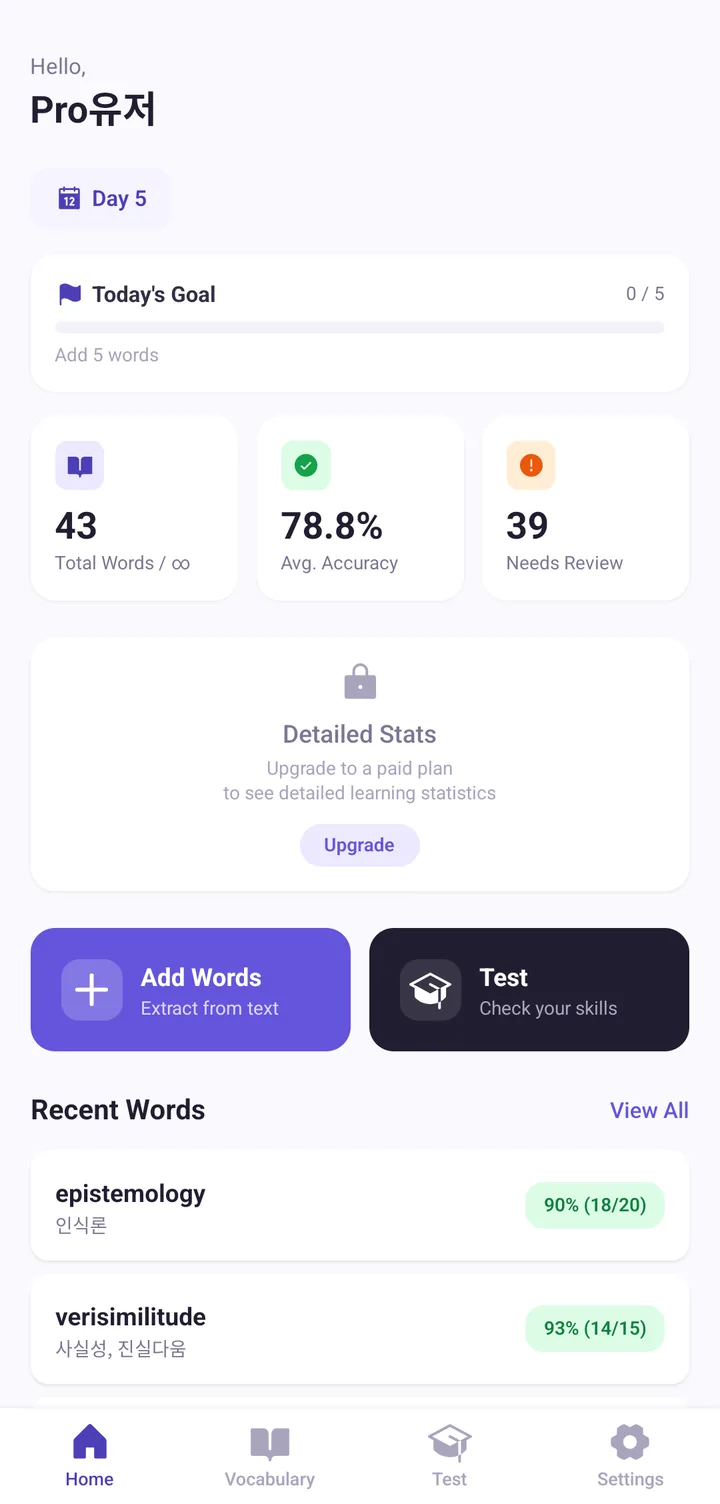
How it works
Four steps to context-based vocabulary learning
Capture a sentence
Paste a sentence you don't fully understand, or snap a photo of it.
AI extracts the key words
AI automatically picks out the words that are worth learning from that sentence.
Take a comparison quiz
Test the exact meaning of each word against similar sentences with close meanings.
Build real fluency
Difficulty auto-adjusts to keep you at a 70-80% success rate, so you stay motivated as you improve.
Built for how you actually learn
Not just another flashcard app. Everything you need for AI-powered, context-first learning.
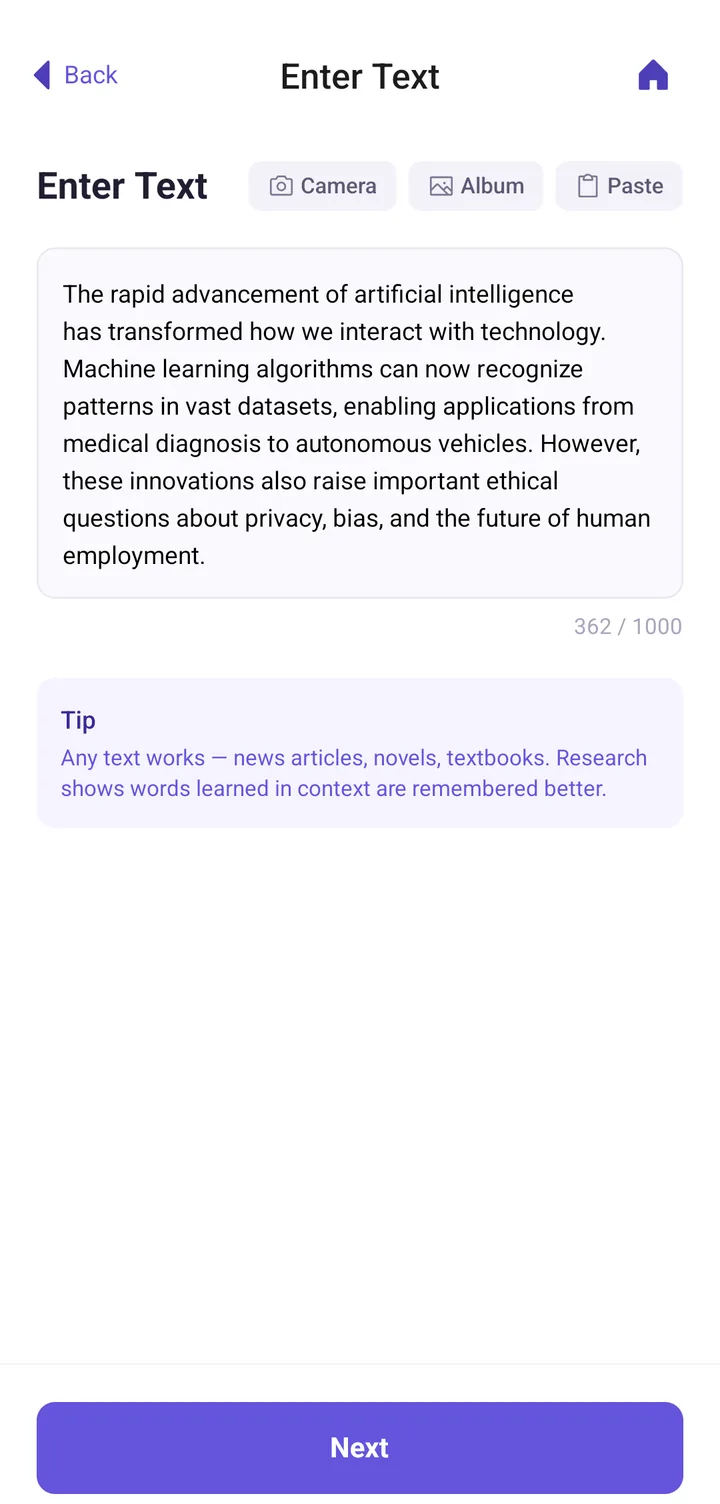
AI keyword extraction
Type or paste a sentence and AI automatically extracts the words worth learning. No more manually hunting for vocabulary.
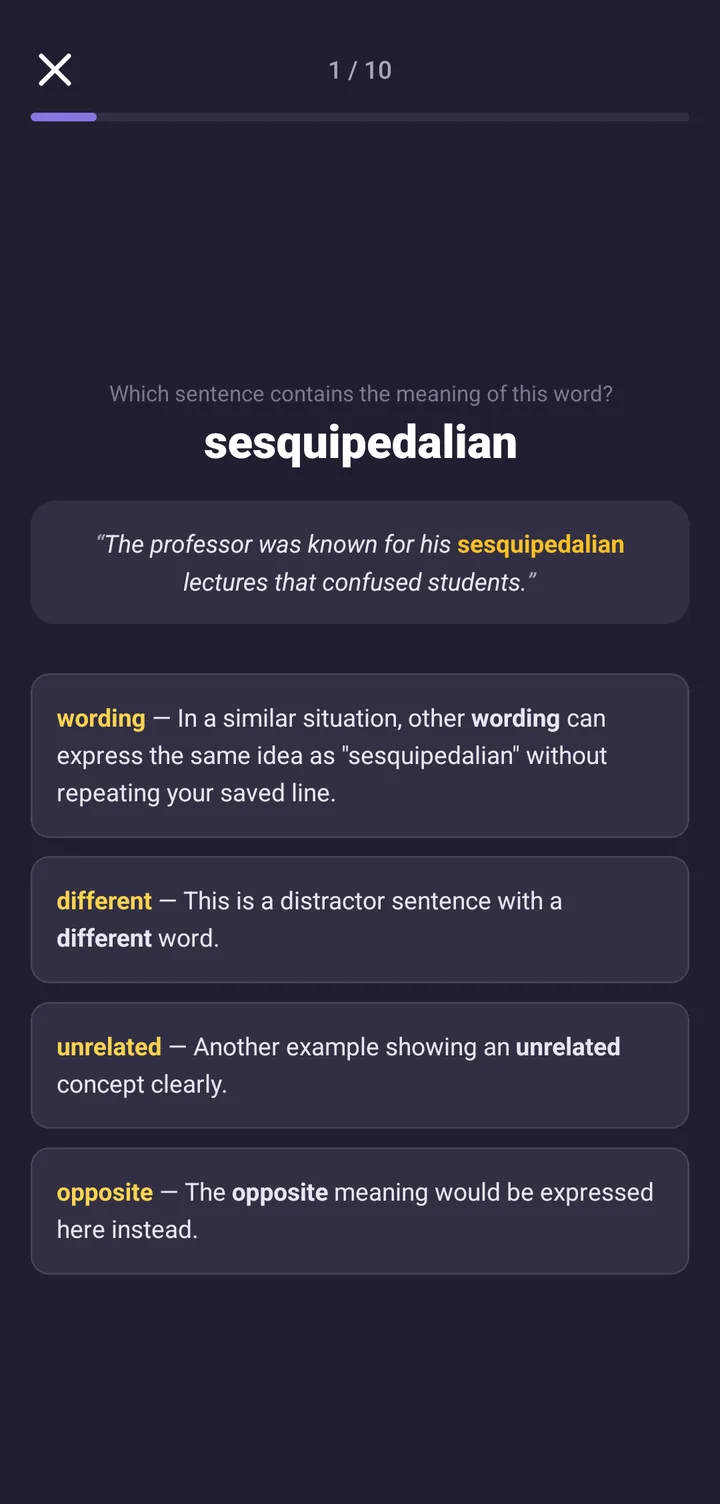
Similar-sentence comparison quiz
AI generates sentences with closely related meanings so you can compare them side by side. No more confusing implement and execute.
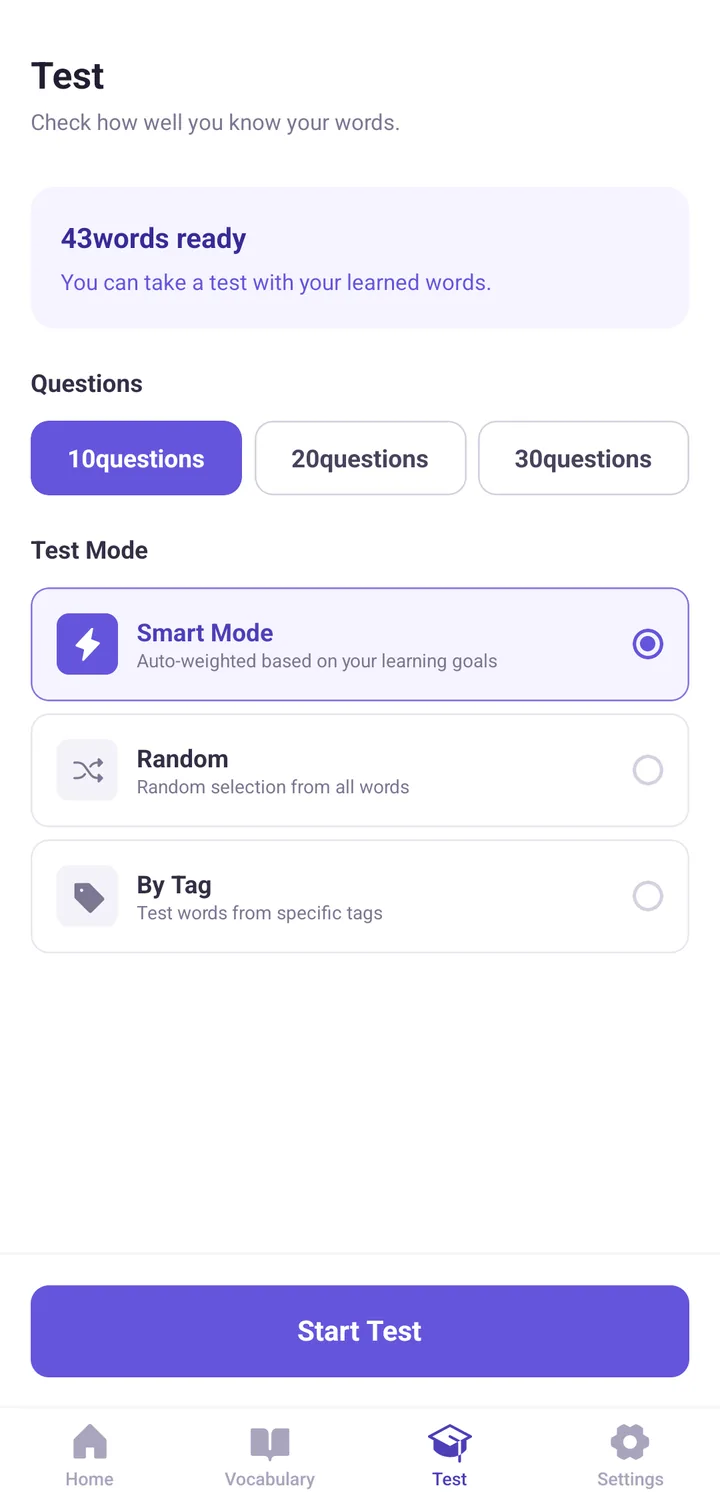
Adaptive difficulty
Difficulty automatically adjusts to keep your success rate around 70-80% — never too easy, never too discouraging.
Tag-based organization
Organize words with tags like TOEIC, exam prep, or business. Pick a category and focus your study session on exactly what you need.
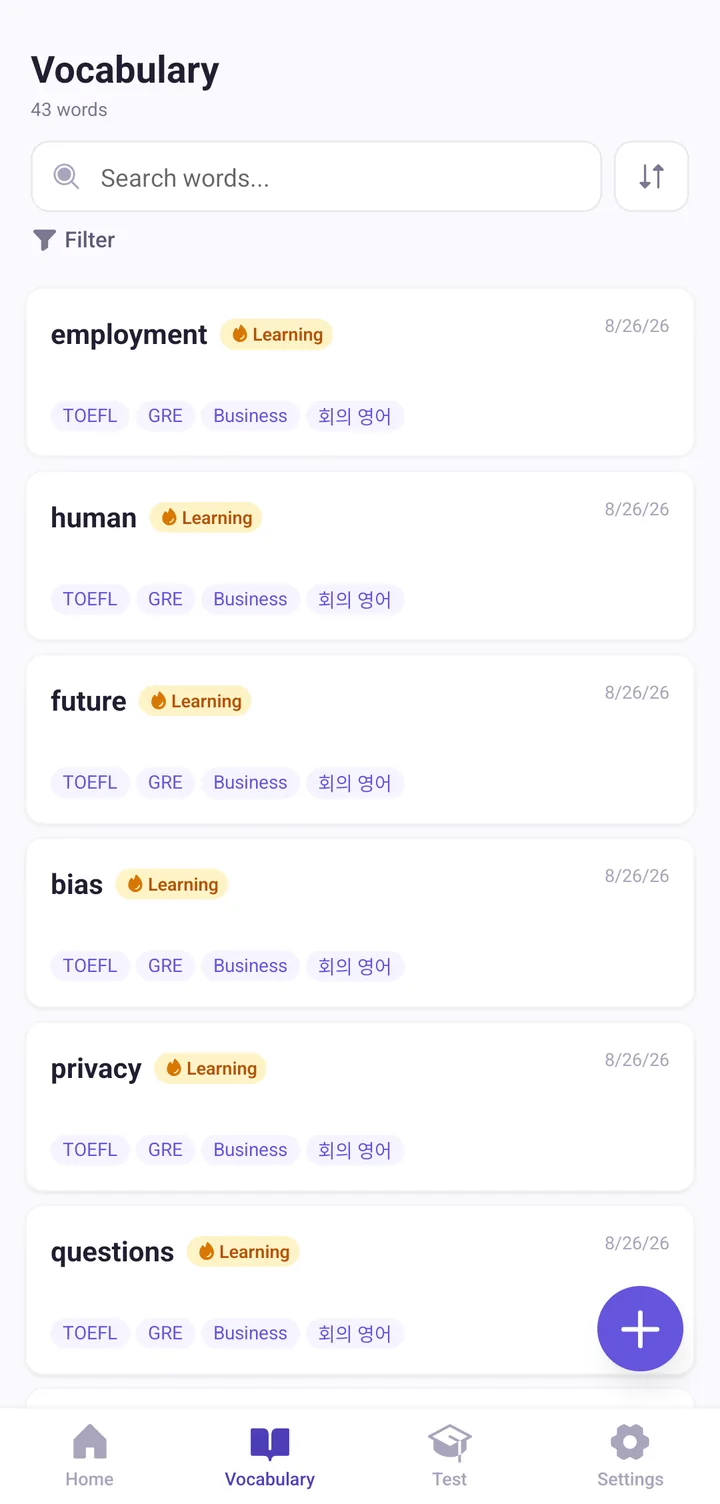
Context-based learning
You don't just memorize a definition — you learn how each word is actually used in a real sentence. That's what makes it stick.
OCR photo recognition
Snap a photo of a textbook or exam paper and the text is recognized automatically. Start learning without typing a thing.
Why It Works — The Learning Science Behind ContextVoca
Every method ContextVoca uses is backed by learning-psychology research.
Learning Vocabulary in Context
Research suggests that encountering a word in an example sentence or context helps you infer and retain its meaning better than memorizing an isolated word.[1] Richer contextual cues have also been shown experimentally to improve vocabulary learning.[2] Completing or producing a sentence yourself has also been shown to leave a longer-lasting memory than simply reading a word.[3]
ContextVoca saves your photos and sentences as-is, and AI extracts the key vocabulary so you learn each word together with its context.
The Forgetting Curve and Decay Model
The forgetting curve observed by psychologist Hermann Ebbinghaus in 1885 showed that forgetting happens fastest right after learning, then levels off.[4] The same curve shape was confirmed again in a 2015 replication study.[5]
- 1 correct answer → 7 days
- 2 in a row → 14 days
- 3 in a row → 30 days
- 4 in a row → 90 days
ContextVoca calculates mastery with a decay model where proficiency fades based on days since your last correct answer, and the half-life grows longer each time you answer correctly in a row.
Retrieval Practice (Quizzes)
Studies show that actively recalling information is more effective for long-term retention than simply rereading it.[6] Reviews of learning-technique effectiveness rank self-testing and spaced practice as the two techniques with the strongest evidence.[7]
ContextVoca's smart quiz uses similar-sentence comparison tests so you practice actively recalling the right answer.
Spaced and Personalized Review
Hundreds of studies have repeatedly confirmed that spacing review out over time is more effective for long-term memory than cramming.[8] The ideal review interval depends on how long you want to remember something.[9] In one study conducted during a semester of middle-school foreign-language classes, personalizing review to each learner's forgetting rate produced final scores 10.0 percentage points higher than uniform spaced review and 16.5 percentage points higher than cramming — this is a research finding, not a result from ContextVoca's own testing.[10]
ContextVoca personalizes when you review by showing words more often when your mastery is low or has decayed, or when your accuracy on a word is lower.

Plausible Wrong Answers
The closer a wrong answer choice is in meaning to the correct one, the more a learner has to think about why it's wrong.[11] Research suggests this process also strengthens related knowledge.[11]
ContextVoca has AI generate wrong-answer choices that are close in meaning to the correct answer, pinpointing exactly where you tend to get confused.
Learn More
Learning How to Learn
Barbara Oakley·Terrence Sejnowski (UC San Diego/McMaster, Coursera)
9.00SC Introduction to Psychology — Memory
MIT OpenCourseWare · CC BY-NC-SA · John Gabrieli · ocw.mit.edu
Desirable Difficulties
Elizabeth·Robert Bjork (UCLA Bjork Learning and Forgetting Lab)
Simple, fair pricing
Start for free, upgrade whenever you need more.
Free
Core learning features
Free, forever
- Save up to 100 words
- OCR text extraction
- AI keyword analysis
- Smart quiz
- 3 custom tags
Basic
Save more words
1,000 words
Save 41% with annual billing
U.S. App Store pricing
- Save up to 1,000 words
- OCR text extraction
- AI keyword analysis
- Smart quiz
- Unlimited tags
Pro
Every feature, unlocked
Unlimited
Save 41% with annual billing
U.S. App Store pricing
- Unlimited word storage
- Everything in Basic
- Detailed learning stats
- Priority support
Lifetime
Pay once, use it for life
Unlimited
One-time purchase
U.S. App Store pricing
- Unlimited word storage
- Everything in Pro
- Lifetime access
- No recurring charges
Start learning today
Learn words in context and meet them again before you forget.
Show references
- [1] Nagy, W. E., Herman, P. A., & Anderson, R. C. (1985). Learning Words From Context. Reading Research Quarterly, 20(2), 233–253.
- [2] Webb, S. (2008). The Effects of Context on Incidental Vocabulary Learning. Reading in a Foreign Language, 20(2), 232–245.
- [3] Hulstijn, J. H., & Laufer, B. (2001). Some Empirical Evidence for the Involvement Load Hypothesis in Vocabulary Acquisition. Language Learning, 51(3), 539–558.
- [4] Ebbinghaus, H. (1885). Über das Gedächtnis. Duncker & Humblot.
- [5] Murre, J. M. J., & Dros, J. (2015). Replication and Analysis of Ebbinghaus' Forgetting Curve. PLOS ONE, 10(7), e0120644. https://doi.org/10.1371/journal.pone.0120644
- [6] Roediger, H. L., & Karpicke, J. D. (2006). Test-Enhanced Learning: Taking Memory Tests Improves Long-Term Retention. Psychological Science, 17(3), 249–255.
- [7] Dunlosky, J., Rawson, K. A., Marsh, E. J., Nathan, M. J., & Willingham, D. T. (2013). Improving Students' Learning With Effective Learning Techniques. Psychological Science in the Public Interest, 14(1), 4–58.
- [8] Cepeda, N. J., Pashler, H., Vul, E., Wixted, J. T., & Rohrer, D. (2006). Distributed Practice in Verbal Recall Tasks: A Review and Quantitative Synthesis. Psychological Bulletin, 132(3), 354–380.
- [9] Cepeda, N. J., Vul, E., Rohrer, D., Wixted, J. T., & Pashler, H. (2008). Spacing Effects in Learning: A Temporal Ridgeline of Optimal Retention. Psychological Science, 19(11), 1095–1102.
- [10] Lindsey, R. V., Shroyer, J. D., Pashler, H., & Mozer, M. C. (2014). Improving Students' Long-Term Knowledge Retention Through Personalized Review. Psychological Science, 25(3), 639–647.
- [11] Little, J. L., & Bjork, E. L. (2015). Optimizing Multiple-Choice Tests as Tools for Learning. Memory & Cognition, 43(1), 85–98.